
Thinking Outside the Box
Abraham Wald - Statistician

What does it mean to “think outside the box”? I believe it generally means that someone is not limited by the traditional ways of thinking about something. In other words, you’re not thinking the way most people do. But it also implies that your thinking is better in some way because you’re not constrained to follow the traditional ways to think about something.
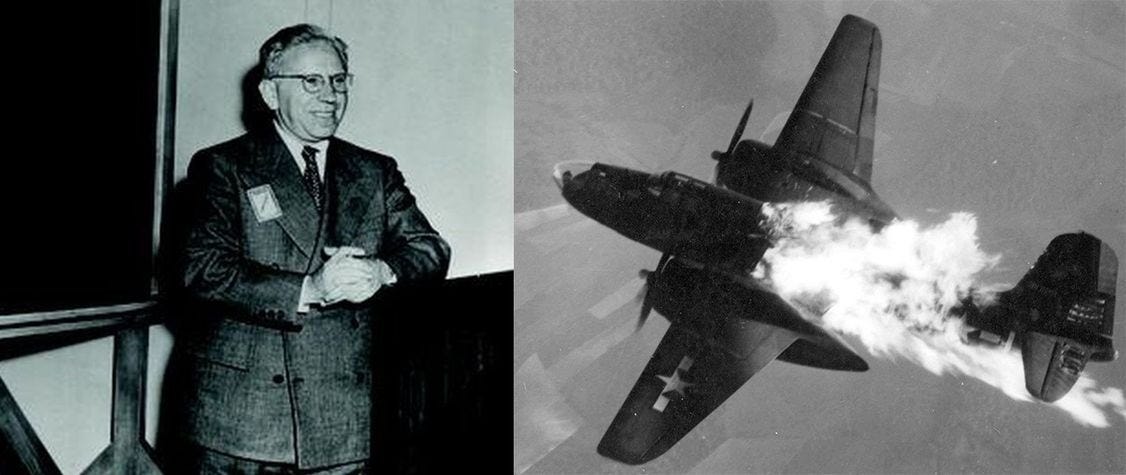
Abraham Wald was a man who solved a big problem for the U.S. Army Air Force in World War II by thinking outside the box. I’m now hoping that by telling his story, and trying to explain what he did, and how he did it in this post, I might be able to discover some new ways for me to solve some of my problems, and possibly even help my wonderful readers solve some of their problems by doing what is called thinking outside the box. Let’s see if telling his story does any of that.
What Did Abraham Wald Do That Was So Unusual at the Time
Abraham Wald was a Statistician at Columbia University when WW II began. He was working in a special group called the Statistical Research Group, formed to help the American government solve unusually complex and difficult problems which required statistical thinking. The problem in which Abraham Wald did his amazing thinking outside the box was the need to add more armor to large bombers flying over Germany. The Army Air Force was losing more planes than it could replace. The Nazi fighters and anti-aircraft weapons were shooting down too many large B-17 and B-24 bombers that flew from bases in England.
The Statistical Research Group was given diagrams showing where bullets had hit the planes carefully recorded by ground crews after the planes returned. Many planes did not return, of course, because Nazi bullets had brought them down over their German targets. The Statistical Research Group was given these diagrams and asked to answer one critical question; where should the Army Air Force apply extra armor to reduce the shocking rate of plane loss? They couldn’t add more than 1,000 pounds of armor to each plane - more added weight would then jeopardize flying ability.
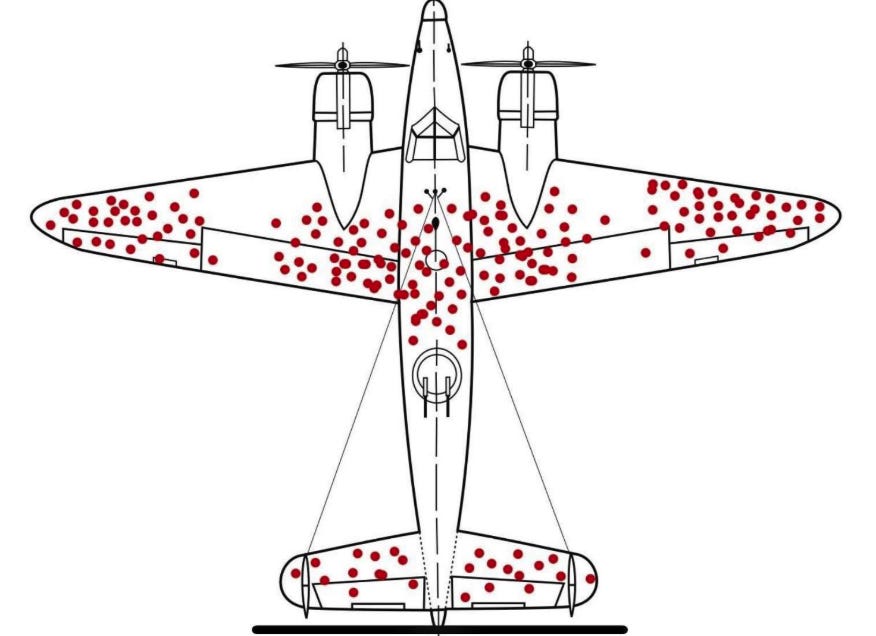
The Statistical Research Group studied the evidence and struggled to answer the big question for two days. Abraham Wald did not participate in the group discussions. He sat alone, just thinking. Then, on the third day, he stood up and made a startling announcement. “You’ve got the wrong sample,” he said, and the other statisticians and military officers didn’t know what to say. Abraham Wald’s thinking out of the box had led him to one conclusion: the bullet hit patterns they needed to see and study were on the planes that had been shot down, not the planes that came back. The shot down planes showed the bullet hit patterns that needed more armor. No one else thought of this solution because they did not have the bullet hit patterns on the shot down planes, but Wald used his expertise in statistics to estimate those patterns.
How Did Wald Predict the Likely Bullet Patterns on the Planes Shot Down?
This is the thinking I cannot provide in this post. I’m not a statistician and he used his advanced mathematical skills to arrive at these conclusions. I only know that his math was universally verified by academics. But I can make two analytical observations based on what I will call common sense.
The bullet hit patterns that brought down the other planes are probably the very ones not seen on the planes that came back.
The bullet hits most likely to bring down a large bomber are probably hits in the engines or in the cockpit of a plane because those are the most vulnerable locations for any plane. A plane that loses an engine or its pilot or co-pilot are assumed to have a substantially reduced likelihood of being able to fly home.
The proof of Abraham Wald’s out of the box thinking includes two kinds of impressive evidence.
As soon as the Army Air Force added more armor to the engines and the cockpit, the areas that Wald recommended, based on his research, the loss rate dropped significantly.
When downed American bombers were found, as the Germans retreated from Allied ground forces, inspections of the downed planes verified Wald’s projected bullet patterns on those planes.
How Important Was Wald’s Thinking Out of the Box?
Abraham Wald’s thinking from this event led to his full development of what is now called Survivorship Bias, a theory now commonly used in many fields extending far beyond its first use to reduce plane and crew loss for the Army Air Force in World War II. Generally speaking, Survivorship bias is a type of sample selection bias that occurs when an individual mistakes a visible successful subgroup as the entire group. In other words, survivorship bias occurs when an individual only considers the surviving observations without considering those data points that didn't “survive” in the event. By looking at this principle more closely, you can see that it has applications far beyond military vulnerability predictions.

Key Aspects of Survivorship Bias
Misleading Data: It creates a skewed picture where the successes are visible, but the failures are invisible or overlooked.
Incomplete Analysis: It focuses on the "survivors" of a process, such as successful companies, living patients, or returning airplanes.
Incorrect Conclusions: It often leads to mistaken correlations or false assumptions about what causes success.
Business Success Stories: Studying only successful companies to determine success factors ignores the thousands of failed companies that used similar strategies.
The last aspect above brought to my mind the common belief that Napoleon Hill’s still popular 1937 book, Think and Grow Rich, offers valuable learning about how to get rich. I think the book is a classic example of people being misled by its survivorship sample bias. I came to this conclusion when I looked at the goal event as getting rich, and then defined two samples viewing each as the likely cause of that effect; the first sample being the rich men Hill interviewed and obtained his casual information from; the second sample being all the other men who thought the same way, and wanted to get rich but didn’t. Hill never considered the second sample.
Promised Effect: Becoming rich by thinking a certain way, as promised by Hill’s book title,Think and Grow Rich.
Sample 1: The rich men that Hill interviewed to develop his thinking recommendations.
Sample 2: All the other men who think the same way and want to be rich but didn’t.
I do not have evidence to verify my assumption but I believe that sample 2 contains far more men than sample 1, and therefore the promise of getting rich by thinking Hill’s way is not a valid conclusion. This way of thinking doesn’t work for more men than it does work for. And this conclusion further suggests that something else must be missing in the book’s cause and effect promise. The missing elements, I believe, are those claimed by critics of the book, as well as my own experience as reported in my Feb 6, 2026 post.

What Can We Learn from Wald’s Story About How to Think Out of the Box?
Use Cause-and-Effect Structures: It seems to me that Abraham Wald Was synthesizing his options into alternative cause-and-effect structures. In other words, I think he kept asking what causes what? This would turn on the logical mind, if he did, and that adds objectivity. This can be a learned habit of thinking when analyzing alternative possibilities.
Embrace the Lonely World of Independent Thinking: Resist the urge to please others and seek to find your own credible conclusions. If there was one thing Abraham Wald had to deal with throughout his life, it was a world that challenged his very existence. He was born into an Orthodox Jewish family and started school just before the Nazi government took power in Germany. He was schooled at home because public schools in Romania then required attendance on Saturdays. His family were intellectuals who encouraged independent thinking, however, and he was able to get into the University of Vienna where he obtained a Ph.D. in mathematics. His published work earned him an invitation to lecture in America in 1938, and it was an invitation that saved his life, literally. Most of his family later died at Auschwitz. He was a survivor of the Holocaust.
Learn How to Learn on Your Own. From the beginning of his life, he was encouraged and often forced to think independently. I think it became his basic habit of mind. These skills are not often taught in schools in America today.
Dan’s Net Take-Away
Based on my reading of his life, I think that Abraham Wald would recommend patient, objective, and honest analysis to achieve thinking out of the box. He was described to be a patient, polite, and very clear lecturer at Columbia. In fact, the notes taken by his students at his lectures reportedly were sought by students at many other universities. To me, he symbolizes the highest level of academic excellence.